Cross-Belt Sorters: The High-Throughput Alternative
When a station or hub outgrows station-scale lines, cross-belt sorters are the next class up: a train of belt-topped carriers that places each parcel positively into its destination, at speeds no manual or diverter line can match.
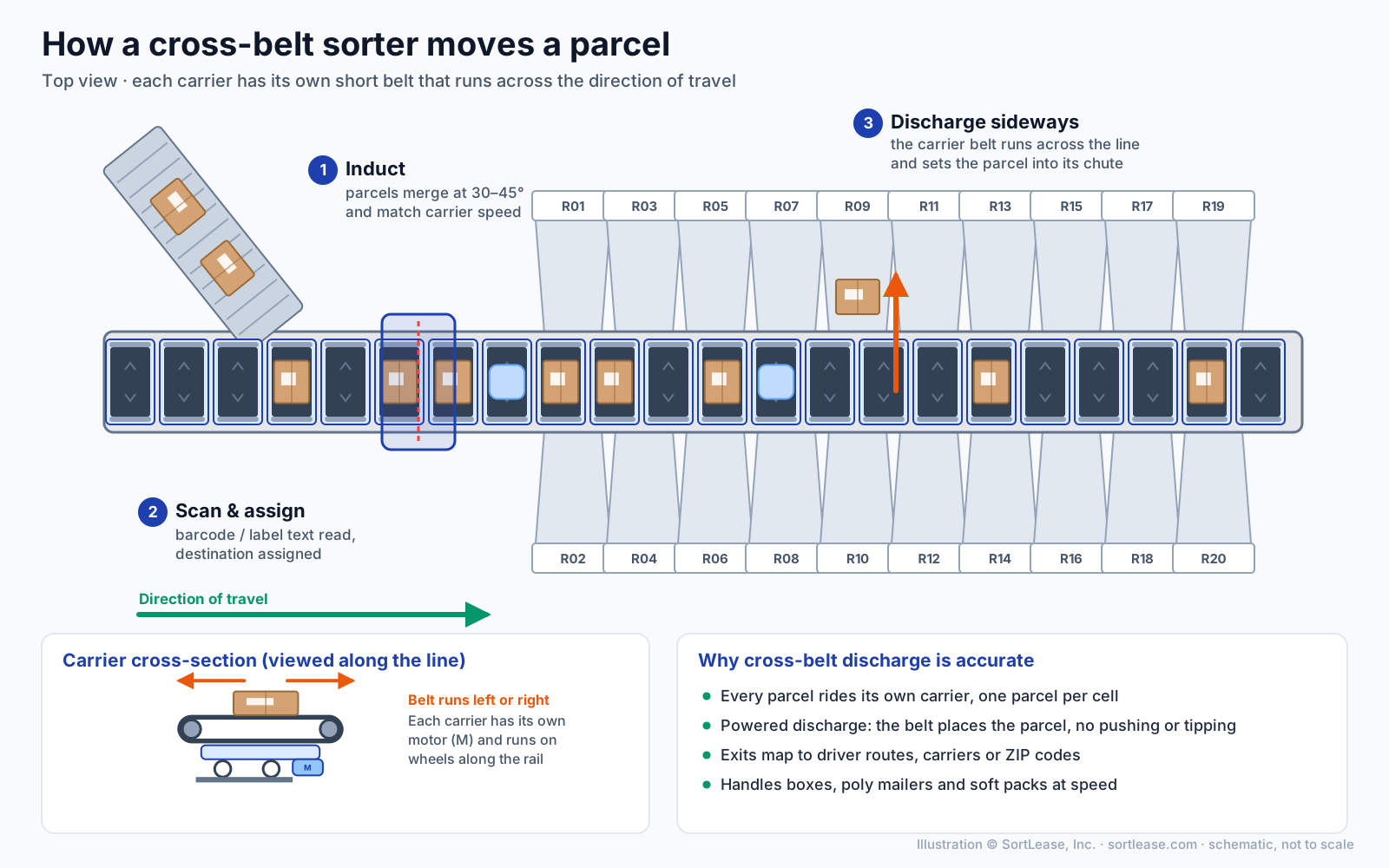
Technical illustration by SortLease, schematic and not to scale. Click to enlarge. Free to reuse with credit.
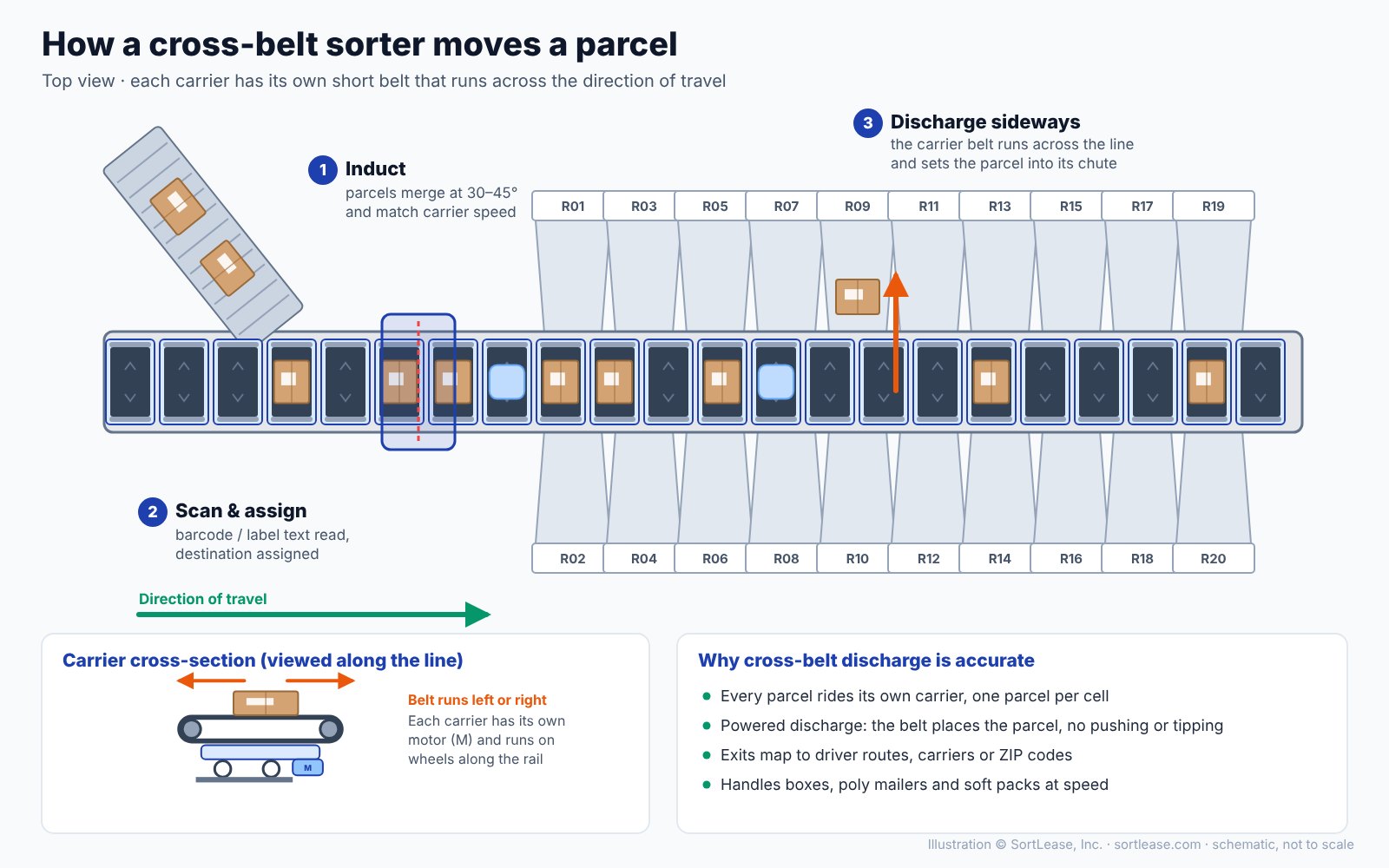
How a Cross-Belt Sorter Moves a Parcel
A cross-belt sorter is a train of small connected carriers, each with its own short belt on top. A parcel is inducted onto one carrier and scanned; as the carrier passes the parcel's destination, its little belt runs sideways — across the direction of travel — and places the parcel gently into the right chute or bin. Because the discharge is powered and positive rather than a push or a drop, cross-belt lines sort a wide mix of parcels accurately at high speed, which is why they are the standard step up for regional hubs and high-volume stations.
1 · Induct
Parcels are fed onto individual carriers at induction stations, timed so each parcel lands centred on its own belt cell.
2 · Scan & assign
The label is read and the sort plan assigns the parcel to a destination — a route, a carrier or a ZIP — before the carrier arrives.
3 · Discharge sideways
At the destination, the carrier's belt runs across the line and sets the parcel into its chute — controlled, not thrown or tipped.
Under each belt the carrier has its own small motor and runs on wheels along a rail; carriers are coupled into a train. Parcels usually join the line at a 30–45° angle and are accelerated to sorter speed so they land without sliding. The diagram at the top of this page shows all three steps from above, with a cross-section of one carrier.
Linear and Loop Cross-Belt Lines, Plus the Narrow-Belt Sorter
Two cross-belt layouts and one close relative cover most high-throughput sort plans. Throughput figures below are the manufacturers' published maximums for each class — the configuration we would deploy is sized to your station, not to the maximum.
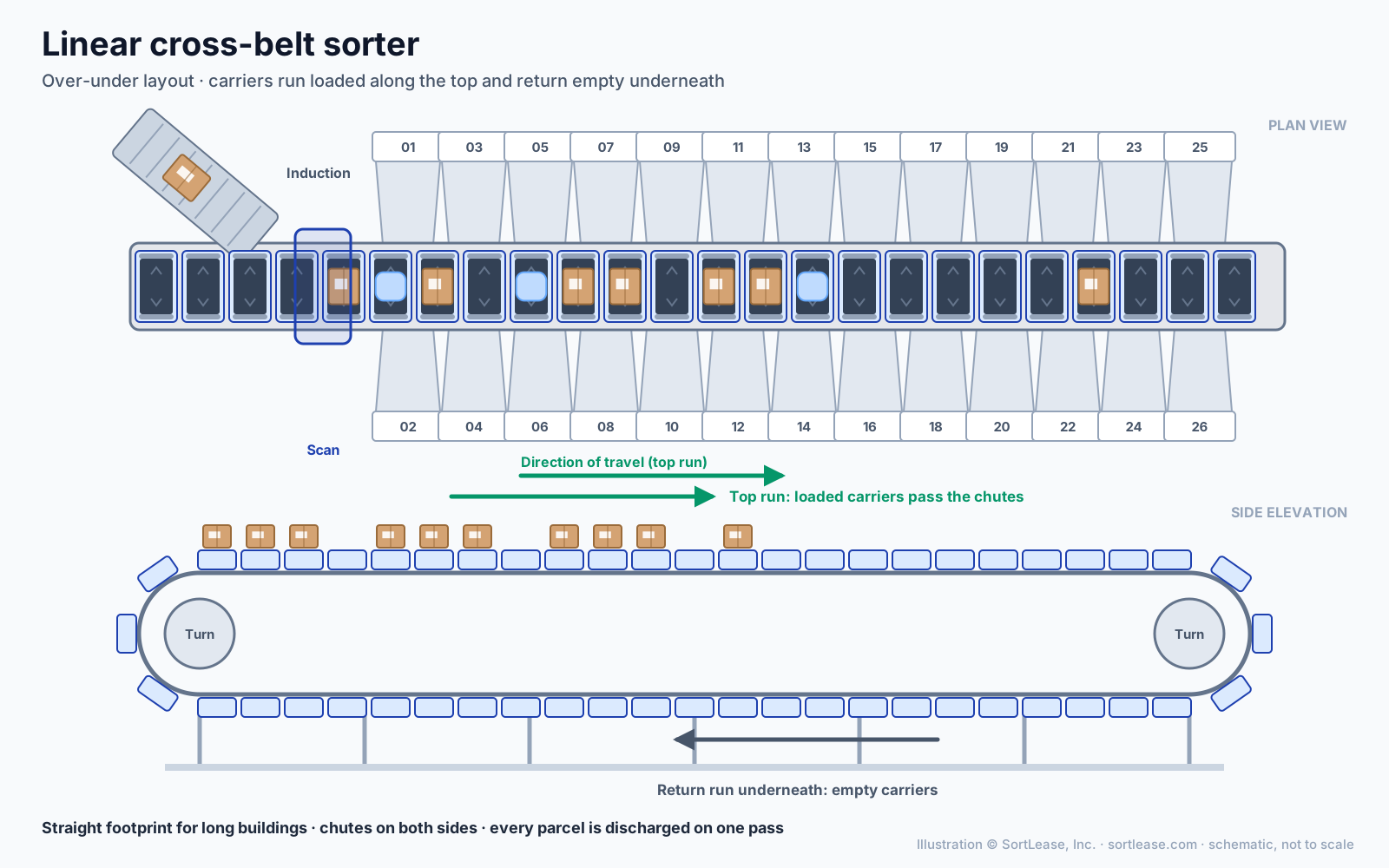
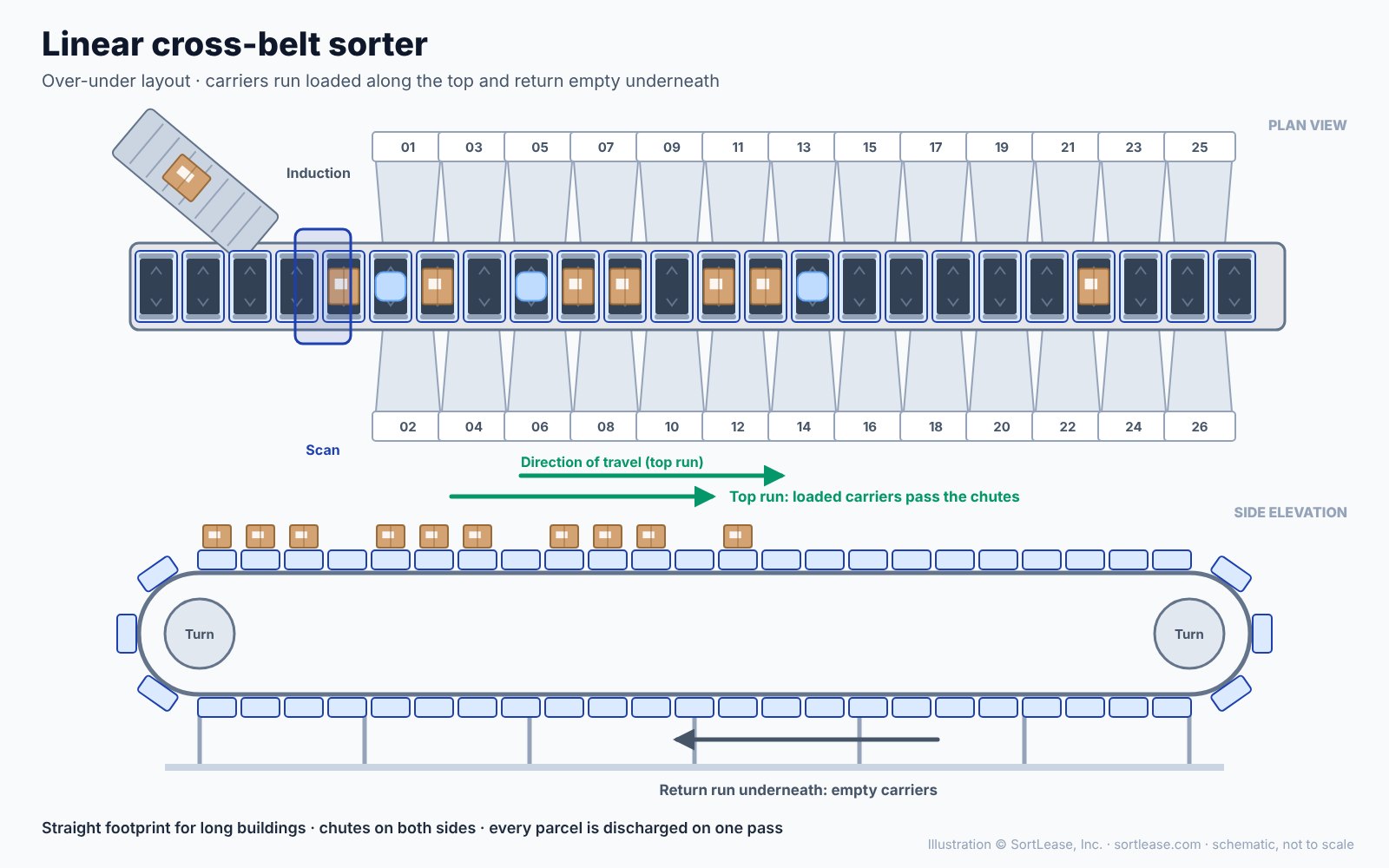
Linear Cross-Belt Sorter
- Published maximum: up to 20,000 parcels per hour
- Layout: one long, straight run with chutes on both sides; in the over-under design, carriers return empty underneath
- Best for: high-volume sort plans that need a long row of chutes on a straight path
The linear layout is the straightforward step up: loaded carriers travel a single straight line past chutes on both sides, turn over at the far end and return empty underneath to the induction end. Because carriers do not come back loaded, every parcel is discharged on one pass. It suits high-volume sort plans in buildings with the length to take it — typically regional hubs and large stations whose morning sort has outgrown smaller lines.
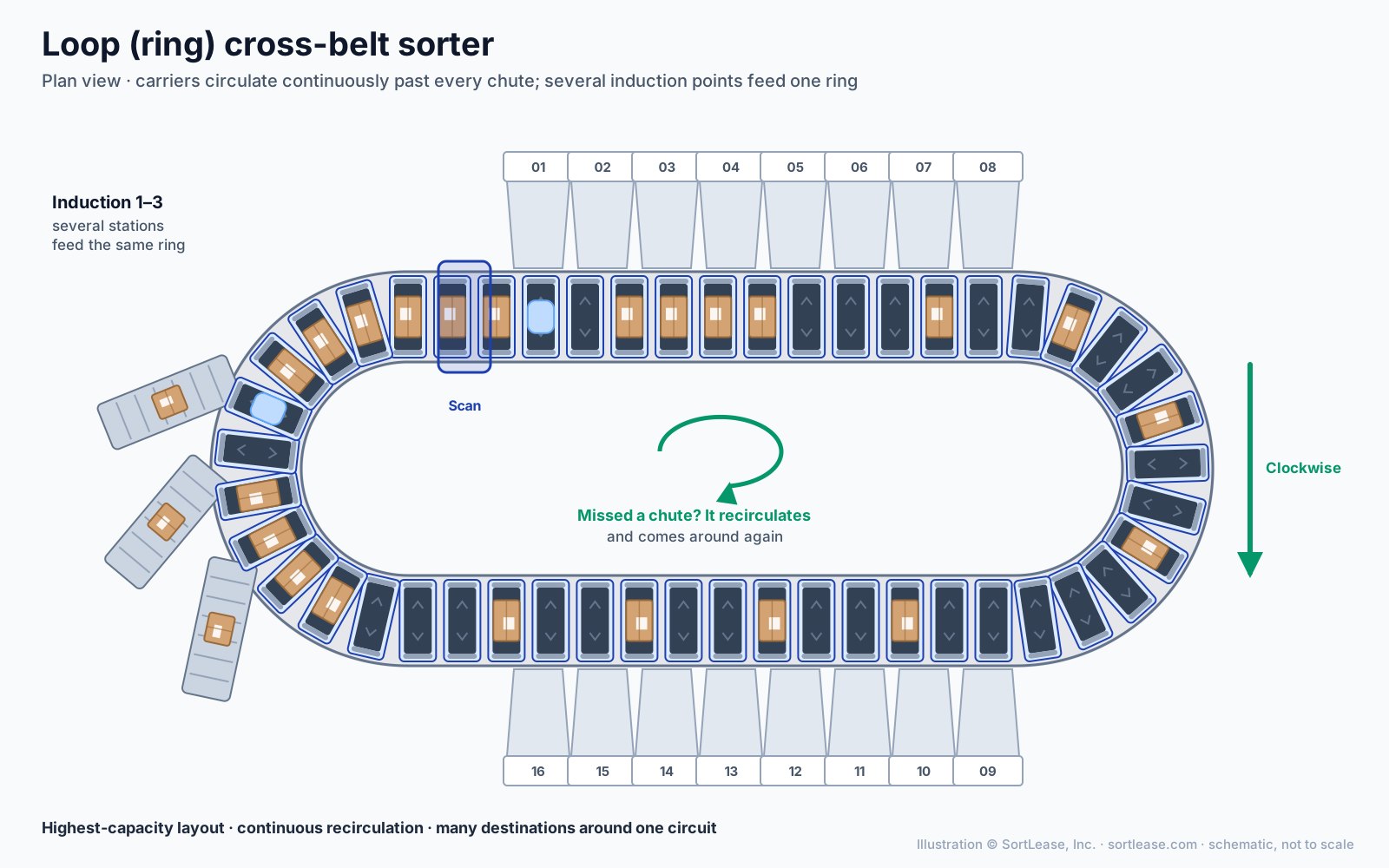
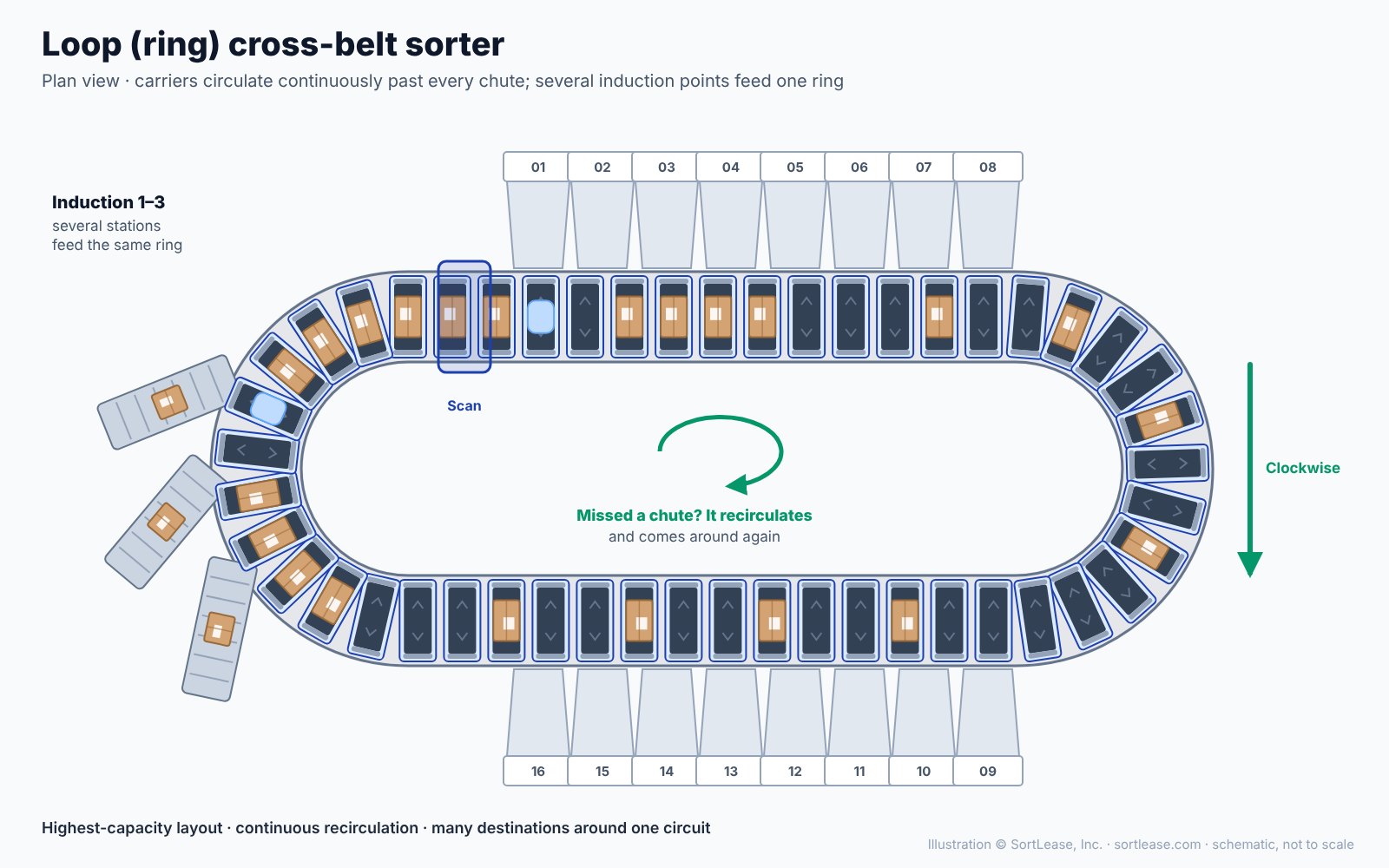
Loop (Ring) Cross-Belt Sorter
- Published maximum: up to 30,000 parcels per hour
- Layout: a continuous circuit — carriers recirculate past every destination
- Best for: the highest-volume hubs, fed from several induction points at once
In a loop line the carriers never leave the circuit: they pass every destination on each lap, so several induction stations can feed the same ring and a parcel that misses its moment simply comes around again. That recirculation is what makes the loop the highest-capacity class — and the natural fit for central hubs sorting for many routes or downstream stations.
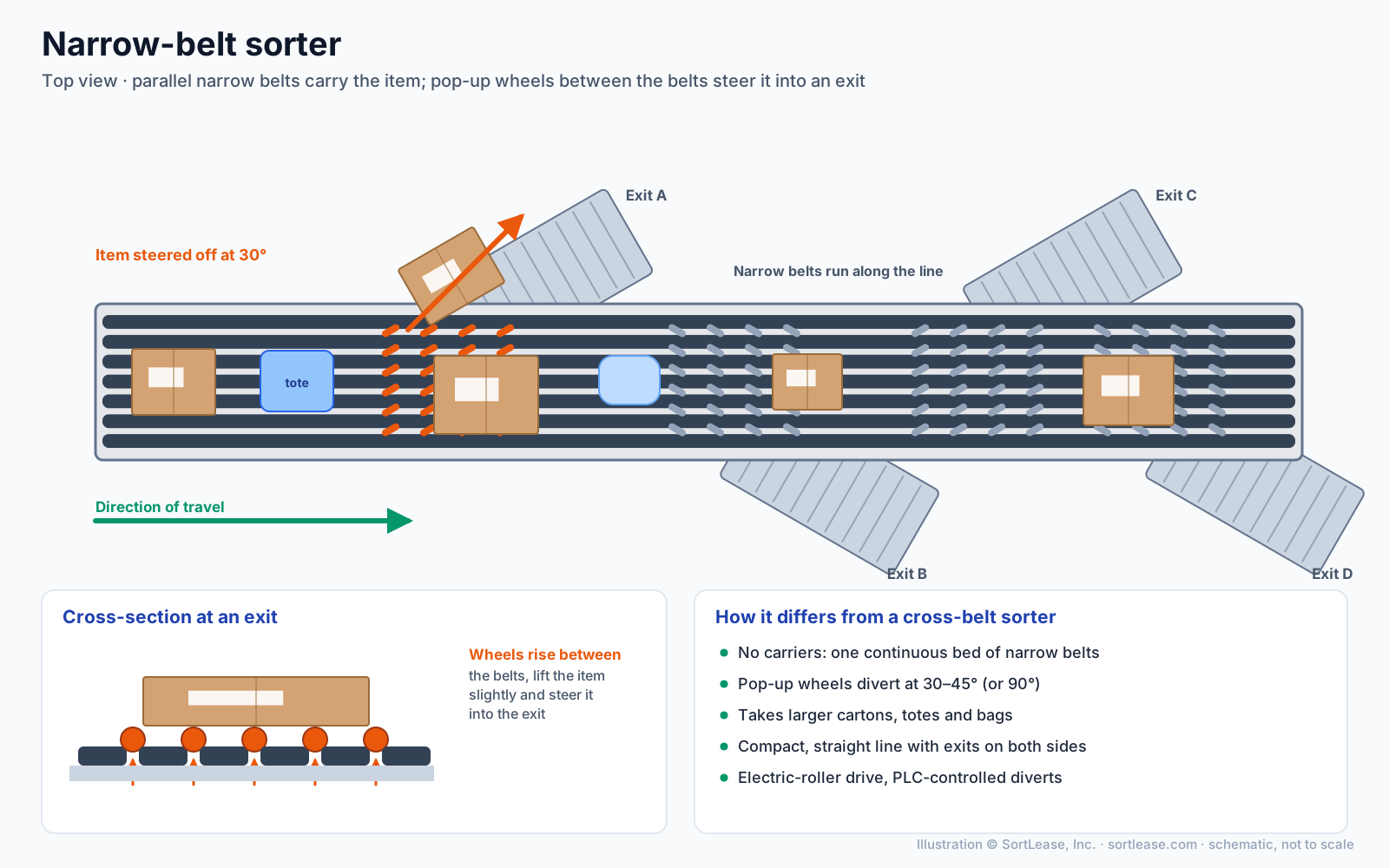
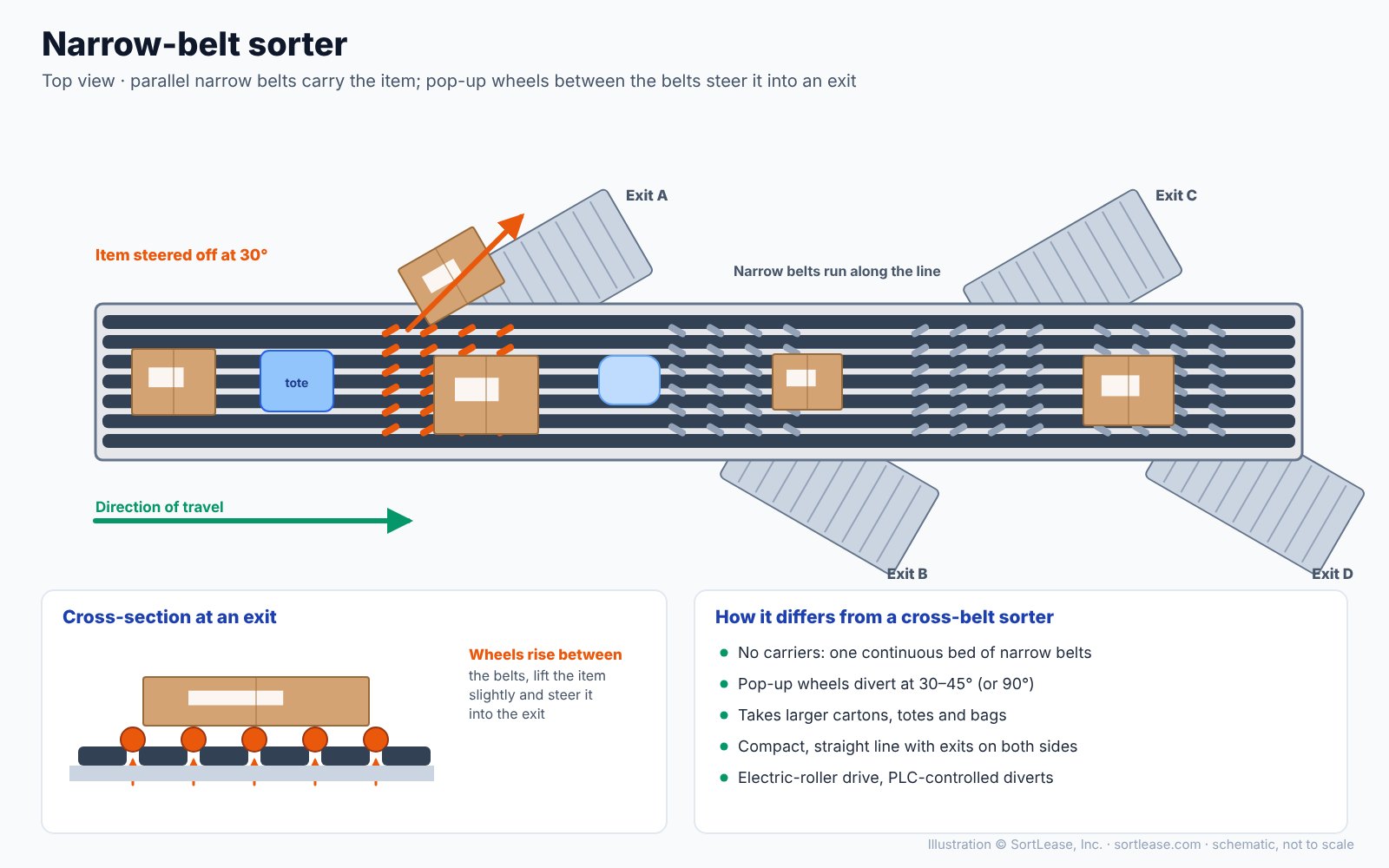
High-Speed Narrow-Belt Sorter
- Published maximum: up to 15,000 parcels per hour
- How it diverts: no carriers; parallel narrow belts carry each item, and pop-up wheels rise between the belts to steer it into an exit at 30–45° (or 90°)
- Drive & control: servo electric-roller drive, industrial PLC control of the Siemens S7 class
- Best for: mixed cartons, totes and bags, including larger items, on a compact straight line
Strictly speaking, the narrow-belt sorter is not a cross-belt sorter, but it is the option most often compared with one. Instead of a train of carriers, the item rides on several narrow belts running side by side. At its exit, powered wheels pop up in the gaps between the belts, lift the item slightly and steer it onto a take-away conveyor. With no carriers to fit, it accepts larger and heavier items than a typical small-parcel cross-belt line, in a straight footprint with exits on both sides. This class is already running in production hubs, including a reference installation in Moscow, which makes it a proven option rather than a paper design.
Cross-Belt Classes Compared
| Class | Published max throughput | How it diverts | Layout | Best for |
|---|---|---|---|---|
| Linear cross-belt | Up to 20,000 parcels/hour | Carrier belt runs sideways | Straight; carriers return underneath | Long, straight high-volume sort plans with destinations along the line |
| Loop (ring) cross-belt | Up to 30,000 parcels/hour | Carrier belt runs sideways | Closed ring with recirculation | Highest-volume hubs; several induction points |
| High-speed narrow-belt sorter | Up to 15,000 parcels/hour | Pop-up wheels between narrow belts | Straight; exits at 30–45° on both sides | Mixed cartons, totes and bags, including larger items, in a compact line |
Figures are manufacturers' published maximums for each equipment class; deployed configurations are sized to each station's volume and layout.
Sorter Terms in Plain English
The words you will meet in any cross-belt or narrow-belt quotation.
- Carrier
- One wheeled unit in a cross-belt train. It carries a short motorised belt, called a cell, that runs across the line.
- Induction
- Where parcels join the sorter, usually merging at 30–45° and accelerated to sorter speed so they land without sliding.
- Scan tunnel
- The arch of cameras or scanners that reads each label (barcode or text) so the sort plan can assign a destination.
- Chute / destination
- The slide, bin or conveyor a parcel is placed into. Each one maps to a driver route, a carrier or a ZIP code.
- Recirculation
- On a loop sorter, a parcel that cannot be discharged stays on the ring and comes around again instead of being rejected.
- Over-under (vertical loop)
- A linear layout where loaded carriers run along the top and return empty underneath, so parcels are sorted in one pass.
- Pop-up wheel divert
- On a narrow-belt sorter, powered wheels rise between the belts and steer an item into its exit at an angle.
- Published maximum
- The highest rate a manufacturer states for an equipment class. A deployed line is sized to the station's peak and sort window.
Free to Reuse These Diagrams
The four sorter diagrams on this page are original illustrations by SortLease, licensed under Creative Commons Attribution 4.0 (CC BY 4.0). Use them in training material, articles or presentations. Please credit Illustration: SortLease (sortlease.com) and link to this page.
No Two Stations Get the Same Line
A published maximum is a ceiling, not a plan. When SortLease deploys a cross-belt line, the configuration is built around the site: the number of destinations or exits follows the station's route plan — around 50 exits is typical when each driver route gets its own chute — the layout runs straight or turns in an L along a wall to fit the floor, and induction, scanning and the sort-plan software are integrated with how the station already works.
For scale, our live deployment in Palm Springs, California runs a wall-side line rated up to 3,600 parcels per hour with 50 driver destinations — the right size for that station. A cross-belt configuration is what we would qualify when a site's volume, parcel mix or growth plan calls for the next class up, supplied and supported the same way: designed, installed, operated and maintained by SortLease, paid per parcel.
Destinations matched to routes
Exits are placed and counted against your route plan — one chute per driver route, or grouped for downstream stations.
Layout fitted to the floor
Straight runs where the building allows, L-shaped runs along a wall where it doesn't — the line fits the site, not the other way round.
Induction & software integrated
Induction stations, label scanning and sort-plan software are set up as one system, so parcels land pre-sorted by route.
Cross-Belt Sorter FAQ
What is a cross-belt sorter?
A cross-belt sorter is a train of small connected carriers, each with its own short belt on top. A parcel is inducted onto a carrier, the carrier travels along the line, and when it reaches the parcel's destination the little belt runs sideways and places the parcel gently into its chute or bin. Because discharge is positive and controlled, cross-belt lines handle a wide mix of parcels at high speed.
Linear or loop cross-belt — which fits my volume?
Linear lines run in a straight path with chutes on both sides and are published at up to 20,000 parcels per hour; in the common over-under layout the carriers return empty underneath, so every parcel is discharged in one pass. Loop (ring) lines circulate continuously and are published at up to 30,000 parcels per hour, the highest-capacity class, suiting large hubs that feed one circuit from several induction points; parcels that miss their chute recirculate. In practice the deployed configuration is sized to your peak parcels per hour and sort window, not to the class maximum.
What is the difference between a cross-belt sorter and a narrow-belt sorter?
A cross-belt sorter moves each parcel on its own carrier and discharges it with a small belt that runs across the line. A narrow-belt sorter has no carriers: several narrow belts run side by side along the line, and at each exit powered pop-up wheels rise between the belts and steer the item off at 30–45° (or 90°). That makes the narrow-belt sorter a compact straight line that also takes larger cartons, totes and bags, while cross-belt lines excel at very high rates of small and mixed parcels.
What parcel sizes can cross-belt sorters handle?
Published class data for linear and loop cross-belt lines covers parcels from small mailers of a few centimetres up to cartons around 200 × 400 × 400 mm, with weights from about 10 g to 10 kg. Narrow-belt sorters, which have no carriers, publish larger envelopes — up to roughly 1500 × 800 × 700 mm and 20 kg. Exact limits depend on the configuration, and the final envelope is confirmed when a line is specified for a station.
Can a cross-belt line be configured for around 50 destinations?
Yes. The number of chutes or exits is a layout decision: destinations are placed along the line (or around the loop) to match the station's route plan, and around 50 destinations — one per driver route — is a typical station-scale configuration. Lines can also be specified with more destinations for larger hubs, and the count is fixed when the configuration is designed for the site.
How does SortLease supply and support cross-belt equipment?
Cross-belt lines are available through SortLease as an alternative equipment option, sourced through our supplier qualification pipeline: SortLease purchases equipment from qualified manufacturers, then designs the layout, installs, operates, maintains and upgrades the system at your station. Customers pay per parcel sorted, from $0.10 per package, instead of buying equipment; systems can also be purchased, quoted per configuration.